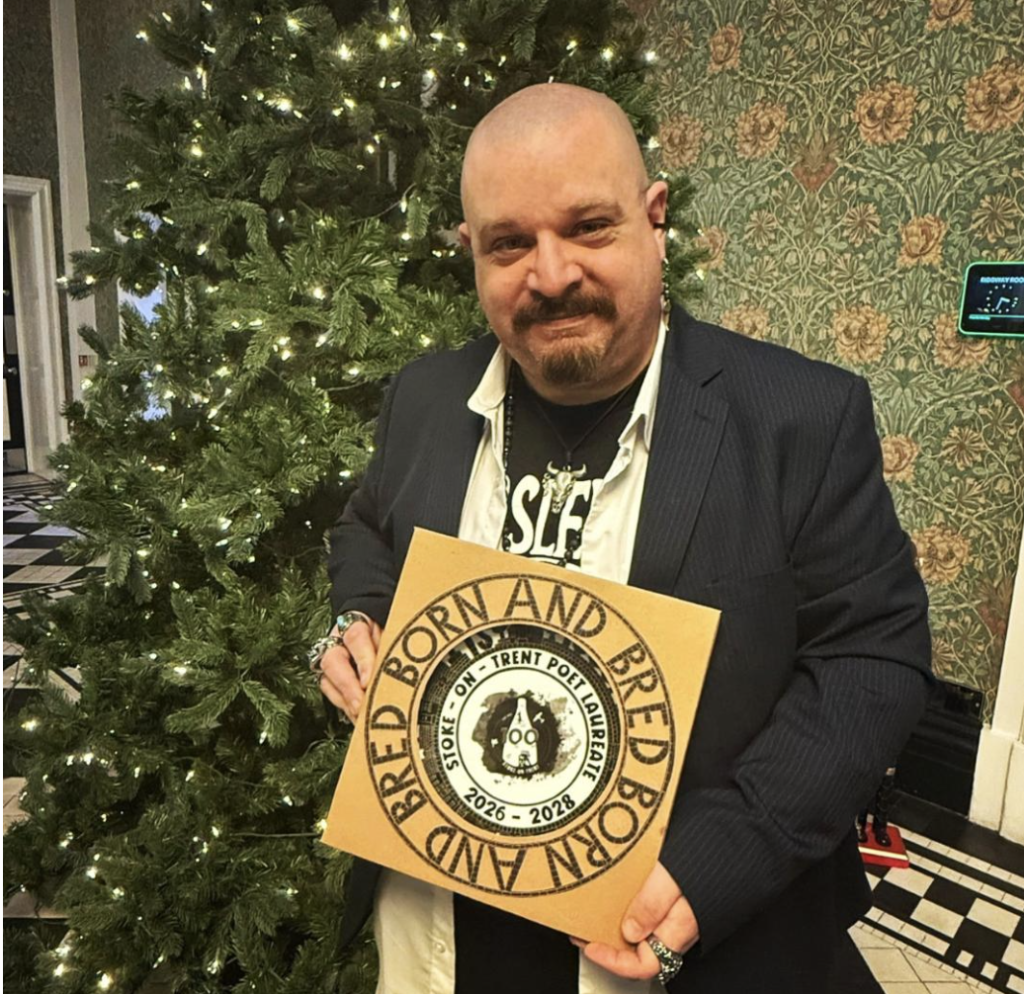
Steven, you have recently been appointed Stoke Poet Laureate, but how did you first find your way into poetry?
I have written poetry since I was in high school, but after leaving school in 2000 it was only something that I did every so often. I had written short stories, pieces of work for the theatre and then in 2014 I adapted some Edgar Allan Poe work into a stage play, and the research into that made me look deeper into poetry, and I started writing poetry more often.
Throughout covid in 2020 I was working between County Hospital, Stafford and Royal Stoke and during this time I became unwell. I was later diagnosed with anxiety. I began cognitive behavioural therapy (CBT) and discussed journalling and poetry as a means of therapy. This prompted me to write more and more, some of it was good, some not so much, but I found getting thoughts on to paper did feel like a weight was lifted. It allowed me to express feelings that I might not have articulated very well had I said them out loud.
From writing poetry predominantly about mental health I branched into writing about the area I live in, the history, and especially my loathing of politics and social media.
I confess that whilst I do write every day, I don’t write poetry every day. Much like a musician with a melody, I have to feel it, and that doesn’t happen every day.
Can you tell us some more about whether your heritage influences your way of writing? Does Stoke feature in your work much?
Yes, it definitely has an influence. I’m extremely proud of being a ‘Stokie’. There is a wealth of history to this area, whether that be culturally or industrially and so much of that can be used in poetry. My poem ‘Ow at Duck’ focuses on these aspects and talks about the pot banks, the local dialect, even shops and bus services that people from the area would be familiar with.
Stoke-on-Trent is sadly the underdog, and I would go so far as to say that I would class my poetry as representing that underdog spirit. It’s about giving a voice to a place and a people who are often overlooked or misunderstood. Stoke doesn’t always get the credit it deserves, but that grit, resilience and sense of community really shape how I write.
I try to capture the humour, warmth and honesty of the area, as well as its struggles. Using local references and dialect isn’t just about authenticity, it’s about pride and preservation. When I write about Stoke I want people from the area to recognise themselves in the work, and for people outside the area to see beyond the stereotypes and understand its richness.
Some of the more politically aimed poetry still has undertones of the working-class background I grew up in and carries an antiestablishment feeling that I think comes from fellow Stokie, and one of my heroes, Lemmy Kilmister.
Do you have any words of wisdom for poets just starting out in their career?
Write, write and write again. It doesn’t matter if it’s badly as long as it’s often, and without apology. Skill grows out of volume and courage, not perfection. Read widely and read everyone. Read works by contemporary poets, the dead, the overlooked. Notice how poems work, the line breaks, when to utilise silence and when to take a risk. There’s no crime borrowing techniques, just not the voice.
The material that scares you, embarrasses you or feels ‘too much’ often means you’ve got something great at your fingertips. Finish your poems, then let them go. Revision matters, but so does release. Send your work out, accept rejection if it comes, but don’t stop. Other poets are not your competition. Share your work, talk about it and listen.
A career in poetry is not a straight line or a quick reward and this I say from experience. If you keep writing, reading, and paying attention the work will change you, and that change is the real success.
You have a number of your own books listed for sale on your website but can you tell us how you went about building your collections and what that process of putting a book together was like?
The first short story I ever had published was a horror called ‘The Voice Within’, which appears in the collection ‘Impossible Spaces’ alongside horror alumni Ramsey Campbell, an achievement I am immensely proud of.
I then had ‘All That We Seem’ published via Stagescripts. This is the adaption of some of the works of Edgar Allan Poe which premiered in 2014. This followed the screenplay for an independent film called ‘Beneath Still Water, a horror tale about the mermaid of Blakemere Pool, Leek.The first book I self-published was a collection of limericks entitled ‘On my Worst Behaviour’ – I book sadly no longer available. This was hard work, as I had no idea how to publish, other than the traditional route and there was no desire from publishers to release a collection of bawdy limericks. I took to Amazon and decided to self-publish. The book took around three months to piece together and reformat, design a book cover etc..
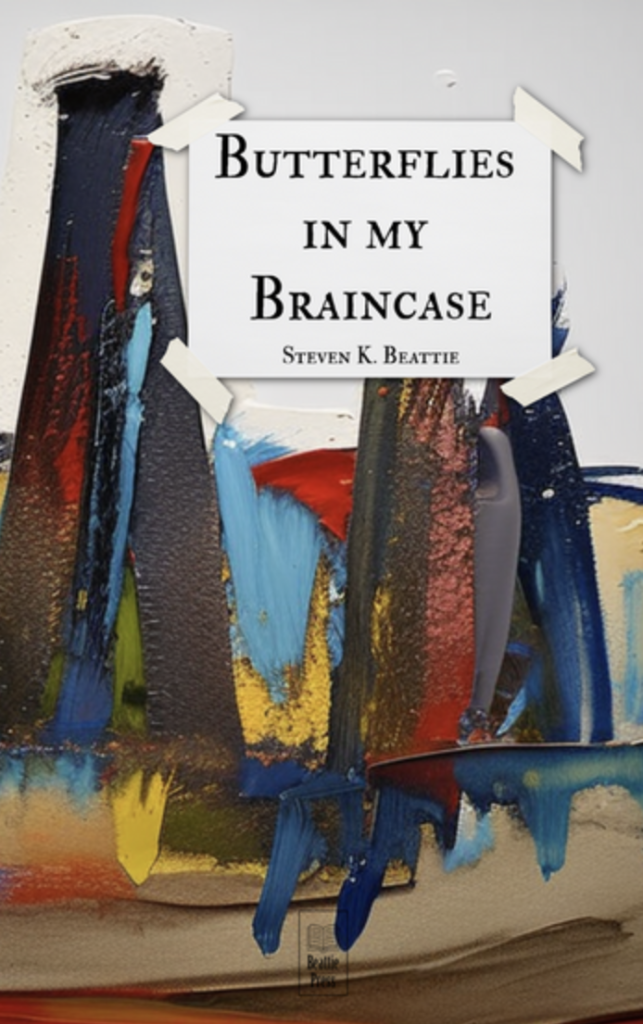
In twelve months from its release the book sold four copies, and one of them was mine. It was a learning experience if nothing else. That then brings me to ‘Butterflies in my Braincase’, my debut poetry collection. At the end of 2024 I found myself with numerous poems and haikus sitting on my PC. I decided to publish. I opted once again to self-publish. I perhaps foolishly thought that a publisher wouldn’t entertain the idea of publishing a collection of poetry from someone they’d never heard of. So once again I started formatting. I had a digital image I’d made some years before of the Three Sisters kilns in Burslem and decided to use this as the image cover. I’m pleased to say that sales of this collection have been far better than the limericks.
The process of self-publishing I found tiring and very often frustrating. I am not a whizz kid when it comes to formatting, and the constant back and forth between pages because words don’t align or words/titles appeared on different pages was challenging. I think self-publishing is a great way of getting writers work in the public arena but it is not without flaws. Design, formatting, promotion and the time it takes to combine these elements is something I think any writer must carefully contemplate before committing to the process.
I’m very proud that ‘Butterflies in my braincase’ is being read and enjoyed by so many now. I’m sure it will be riddled with errors, but you know what? I’m human, so me too.
Ow at Duck?
Steven Beattie
“Cost kick a bo?” and “Ow at duck?”
said tenderly through the grime and muck,
as ancient as the clouds which formed the coaly smoke
but proudly are spoken, by those whose hearts beat in Stoke.
For those words are carved in clay and fuelled by coal,
and gave the six towns a heart and gave fire to its soul.
From the towering kilns and below the dusty streets,
through the alleys and the cobbled stones beneath our feet,
our artisans performed with skill and with grace,
as they conducted their symphony with the clay they’d embrace.
Wedgewood’s history is coloured in blue and in white,
with the kilns all ablaze when the fires burned bright.
From the shafts of Sneyd colliery down to the bowels of Hem Heath,
the coal came atop from the men far beneath,
and as the lamps lit their eyes in the darkness around,
they dug through the earth, dug deep underground.
Some won’t come home, though their wives sit and pray,
like the souls that were lost on a cold New Years Day.
The air smelt of woodbines and cough drops from Old Betty Plant’s,
and the children played hopscotch in hand-me-down pants.
At home in the front room Nana sat darning her drapery,
with a plate of iced buns bought from Mr Cartwright’s bakery.
To Brown Edge with Turners, where old grandad was born,
then it’s back “a fare and ‘alf, t’top o’Smallthorne”.
With tales told by Bennett and Berry to be read through the ages,
our folklore is written on history’s blank pages.
Penned by blackened fingers and hands which are dried,
by the men and the woman, who all their lives they have tried,
to remain in good spirits, and wish each other good luck,
when they pass by in the street and ask, “Ow at duck”.